


Why Are My Credit Card Processing Fees So High?
Thousands a month in card fees and nobody ever told you why? MTech founder Samir Kadi breaks down the four factors driving your credit card processing fees, the hidden padding processors add on top, and how dual pricing gets you to essentially zero.
By the MTech Distributors team, with Samir Kadi, Founder & CEO
You open your monthly processing statement, scroll to the bottom, and there it is again. Thousands of dollars gone to credit card processing fees. And the worst part? Nobody ever explained to you why it's that high.
So we sat down with MTech founder Samir Kadi and asked him the question every business owner eventually asks: why are my credit card processing fees so high?
His answer: "There's a couple of factors that play into that." Some of them you can control. Some of them you can't. Let's break down every one, in his words, and then get into the fix he recommends to almost every merchant he talks to.
Factor #1: The processor you're working with
The first thing Samir looks at is simple: who's processing your cards, and what are they actually charging you?
"One is the processor you're working with. Are they giving you a good rate? You know what rate you're on? You know what they're charging you?"
Most owners can't answer those three questions off the top of their head. That's not your fault. Statements are built to be confusing. But if you don't know your rate, you can't know if you're overpaying.
Factor #2: Card present vs. card not present
How the card gets run matters just as much as who runs it. If you take a lot of orders over the phone, you're what the industry calls a MOTO account (mail order / telephone order).
"It's not card present. It's card not present. Card not present transactions are usually very high in rate, right? Because it cannot be verified with a chip. Therefore, it's more costly."
When a card is dipped or tapped at your counter, the chip proves the card is real. When someone reads their number to you over the phone, nothing gets verified. More risk for the bank means a higher rate for you.
Samir puts it in four buckets that all affect your cost: card present, card not present, high risk, and e-commerce. The more of your volume that's card not present, the more you'll pay.
Factor #3: The type of cards your customers carry
You don't pick which card your customer pulls out. But that card decides a big chunk of your rate. Samir breaks it into four types, from most expensive to cheapest:
Corporate / business-to-business: Points, cash back, miles, free flights, "the whole nine yards." Pushes your rate up to 3% to 3.2%.
Small business rewards: Simple rewards, a little cash back. About 2.79% to 3%.
Personal rewards: Some points, less than corporate. About 2.2% to 2.5%.
Plain, no-rewards cards: Nothing. "You use it and you go." The cheapest, starting around 1.69% to 1.79%.
His way of picturing that last row: "Think of credit cards that your mom and dad used back in the 80s and 90s." No points, no miles, no cash back. Every perk on a fancy card gets paid for by somebody, and that somebody is the merchant.
Factor #4: Small tickets and debit cards
This is the one that surprises people. Debit is supposed to be cheap, right? On a big ticket, it is. On a small ticket, it can hurt.
"If you're a grocery store and your average ticket is $2 or $5… your rate's going to be high on debit cards because debit cards come with an actual fixed cost."
That fixed cost is about 22 cents on every debit swipe, no matter the sale amount. Look at what that does as a percentage:
On an $80 to $90 restaurant check, 22 cents is a rounding error. "Your rate's going to be low on debit cards."
On a $2 coffee or a $3 bag of chips, that same 22 cents is roughly 7% to 11% of the sale before anyone adds a markup.
Volume plays in too. Samir points out that supermarkets "qualify for a much cheaper rate just because of the volume that they have." His rule of thumb: "If your volume is really low and your average ticket is really low, then your rates are going to be definitely higher."
The part nobody explains: the "padding" on top
Every card brand charges a base cost on every transaction. Samir is straight about where your fee goes from there.
"All these numbers are taken in by the bank on the back end. They're billed to the bank through Visa, Mastercard, Discover, American Express… and those fees are forwarded to the merchant."
Then the processor adds their cut on top. It's called interchange pass-through: whatever the card brand charges gets passed to you, plus a markup.
"So whatever the rate is, they'll just put a padding on top in order for them to make a profit."
Here's what that looks like on a debit swipe. The base cost is about 22 cents. A processor adds another 5 cents plus a few basis points. Now your real cost is 27 cents and change, on every single transaction.
Is the padding always a bad thing? Not according to Samir. That margin is supposed to pay for the people "answering your phone calls, looking up your statements," and handling your chargebacks. The problem is when you're paying for that support and not getting it.
That's also why he says there's "no such thing as a real flat rate." Your cost changes with every card that gets swiped. A flat rate like 2.69% + 30 cents is really a bundle: some transactions cost the processor 1.8%, some cost 3%, and the average gets padded to cover it.
The fix Samir recommends: dual pricing
You can shop around for a lower rate. But you can't control which cards walk through your door. So Samir's answer isn't chasing a slightly better percentage. It's taking the fee off your plate.
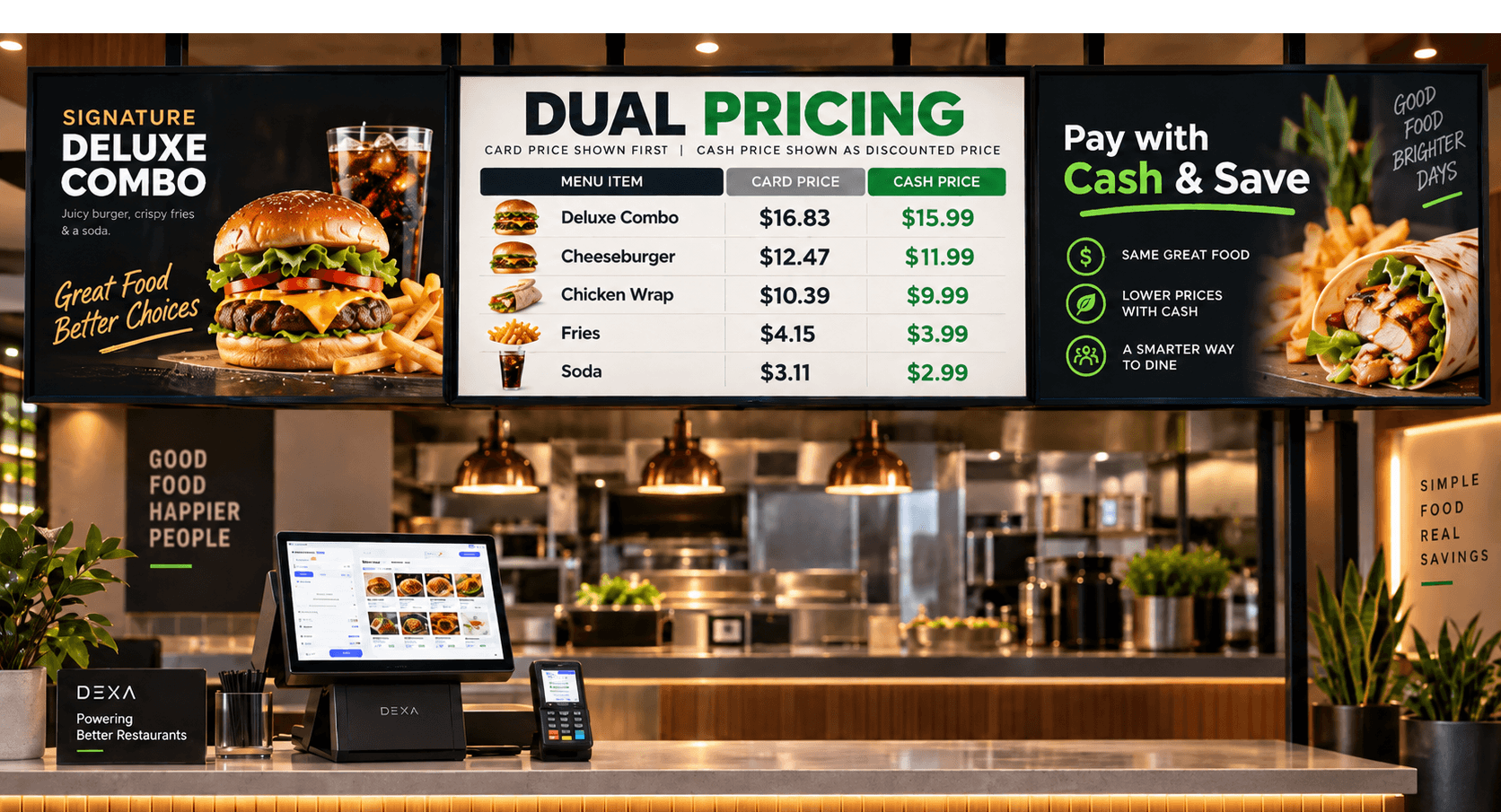
"My suggestion is dual pricing. It's a true cash discount program. You raise your regular prices to cover your card fees, and then you give a discount for people who are paying in cash."
Two prices, shown upfront. The customer picks. Pay cash, get the lower price. Pay by card, pay the card price. "You're giving them an incentive to pay with cash," Samir says. "It's a savings for both parties."
And for the merchant, the result is the big one: "You're essentially paying zero fees."
Why it works: $0.40 vs. $4,000
This is the example that makes it click. A customer buys something for $10 and pays by card.
"Their amount comes out to $10.40, which is no big deal, right? For the merchant, they have 10,000 customers coming in a month and charging $10. That 40 cents quickly becomes $4,000 in fees. You see the difference?"
The fee on a $10 sale: 40 cents for one customer. $4,000 a month for your business (10,000 card sales a month).
Over a year: Barely noticeable for one customer. $48,000 for your business.
Forty cents doesn't change anyone's day. Forty-eight thousand dollars a year changes your business.
Quick answers
Why are my credit card processing fees so high? Usually it's a mix of four things: the rate your processor gives you, how much of your volume is card not present, the types of cards your customers use, and your average ticket size. Low volume plus small tickets almost always means higher rates.
Why are card not present transactions more expensive? Because the card can't be verified with a chip. Phone orders, keyed-in cards, and online payments carry more risk, so they cost more.
Why do debit cards cost so much on small sales? Debit comes with a fixed cost of about 22 cents per transaction. On a $90 check that's tiny. On a $3 sale it's a big percentage of the ticket.
Is there such a thing as a true flat rate? Not really. In Samir's words, "there is no such thing as a real flat rate." A flat rate is a blended average of every card type, with a markup on top.
How do I lower my credit card processing fees? Dual pricing. You show two prices, a cash price and a card price, and the customer chooses. Merchants on dual pricing are "essentially paying zero fees."
Find out what you're really paying
You don't need a finance degree to read your processing statement. You just need someone to walk you through it.
Send us one recent statement. We'll show you your real rate, where the padding is, and exactly what you'd keep with dual pricing. No contract, no cancellation fee, and a real person on the phone.
Call 888-411-7583 or get your free savings quote.
MTech Distributors has helped 5,000+ businesses across all 50 states since 2017.